
ラフマ配合 [ グリシン GABA テアニン 不使用] 睡眠 の 質を高める (30日用)

即効チャージ 持続型 栄養機能食品 AMBiQUE (通常サイズ×1袋)

マルチビタミン 超吸収 医師監修 日本製 KITEN 120粒 30日分

ラクトフェリン 鉄分 国産 1袋(90粒 30日分)
ミトコンドリア発想成分 還元型コエンザイムQ10も配合 ベルタプレリズム



This blog uses affiliate advertising.
When I hear someone say they made money in stocks, does that mean there are people who can predict whether stock prices will go up or down?
Many people are probably wondering about the answer to this question.

However, to be blunt, the truth is nobody knows whether it will go up or down.
Even if one can explain things with various reasons, it's ultimately a matter of probability. The outcome changes depending on various underlying conditions.

Some people make predictions based on their own theories using all sorts of indicators, but no one has succeeded in devising a method that guarantees profits.

It is extremely difficult to predict whether the market as a whole will rise or fall with a certain degree of accuracy.
Since companies that go public are highly likely to see their performance increase in the long run, it's natural to bet on stock prices going up and win.

However, you never know how much it will rise or in what period.

Is it a 1% increase over 20 years, or a 5% increase in one year?
If you want to make money in the stock market, the latter is obviously the better option, but it’s impossible to predict how much a stock will rise in a year.
Even if you're right in the end, it's best to consider it as hindsight.

People tend to predict good outcomes.
You probably buy because you think, "This stock is definitely going to go up," but in reality, sometimes your prediction will be right and it will go up, and sometimes it will be wrong.

Therefore, "absolutely" is a forbidden word in investing.

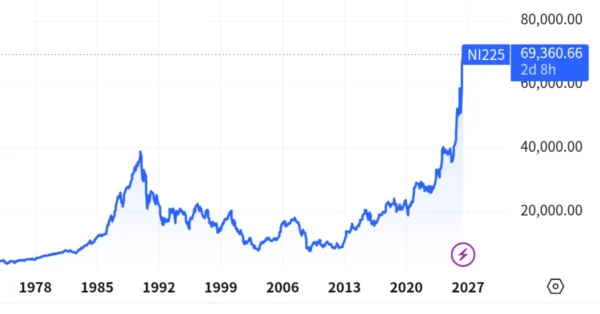
People who bought at the peak of the Showa bubble likely suffered significant losses.
Everyone thought it would "definitely go up", but it was wonderfully betrayed.
Those who cut their losses early might be able to say it was for the best. Are there perhaps some who endured and were finally able to recover recently?

In other words, it's important not to over-invest, no matter how confident you are in a situation.
Have you ever heard that in investing, you need to take on risk to get returns?
It is sometimes said that you cannot get a return without taking a risk.

When you say that, I feel like gambling. However, my personal opinion is that gambling is bad in investment. The risks in investment are different from those in gambling.

What is the risk referred to here?

It's not just about exposing your money to the market. In my own words, not general financial theory, risk is,Probability of profitとProbability of losingis involved. When buying stocks, it can be rephrased as the probability of it going up and the probability of it going down.

Whether it goes up or down, both are probability, so you can't know in advance. That's why thinking about probability is important. And it's important to understand that "you don't know what will happen."

If you understand that risk is not merely "danger" but "uncertainty of probability," you will realize that high risk does not necessarily lead to high return.

Originally, the magnitude of risk and the magnitude of return are essentially unrelated. Gambling and investing are the same in that a large bet yields a large payoff when it wins, but what's important is not to be blinded by flashy returns, but to identify where the "probability of winning (edge)" lies.
The probabilities of rising and falling are determined by the mindset of market participants.Information that could revolutionize your stock investments
Market participants reference indicators like P/E ratios and signals like moving averages because many are looking at them.
It's not that low P/E is a buy signal, but rather that low P/E is a buy signal because many people think it's undervalued.
When the moving average is crossed, it's not that the price will rise, but because many people think the price will rise, they buy.
So, it's not the market that determines stock prices, but rather how market participants perceive them.
So, the probability of the stock price going up or down from here is determined by the number of people who think it will go up versus the number of people who think it will go down, and the degree of confidence each of those people has.
If many people are confident that it will rise, the stock price will rise.
Conversely, if many people think it will definitely go down, it will go down.
So, do you think stock prices will go up or down in the future?
Tomorrow's stock prices will be determined by how strong the participants' beliefs are.
The end



 [2026 Edition] The Ultimate Guide to Japan's EV Charging Services: A Complete Comparison from ZESP3 to Free Plans ★ A Manual for Choosing the "Strongest Charging Card" for All EV Users, No More Hesitation!
 [Family Health] Is It True That “A Longer Life Is Better”? The Reality of “Metabolism” and “Healthy Life Expectancy” Based on Data